Learning Outcomes
i. Derive the equation for centripetal acceleration, a = v²/r, which represents the acceleration of an object moving in a circular path.
ii. Understand that centripetal acceleration is always directed towards the center of the circular path, causing the object to continuously change its direction.
iii. Comprehend the relationship between centripetal acceleration, linear velocity (v), and radius of curvature (r), recognizing that higher speeds or smaller radii lead to greater centripetal accelerations.
iv. Recognize that centripetal acceleration is a vector quantity, having both magnitude and direction, and is measured in meters per second squared (m/s²).
v. Apply the concept of centripetal acceleration to analyze and solve problems involving circular motion, such as determining the centripetal acceleration of a car turning on a circular track or a satellite orbiting the Earth.
Introduction
In our previous lessons, we explored the concept of motion in curved paths and introduced the centripetal force, the force that keeps objects on their curved trajectories. In this lesson, we delve deeper into the realm of circular motion by investigating centripetal acceleration, the acceleration experienced by an object moving in a circular path.
i. Deriving the Equation for Centripetal Acceleration
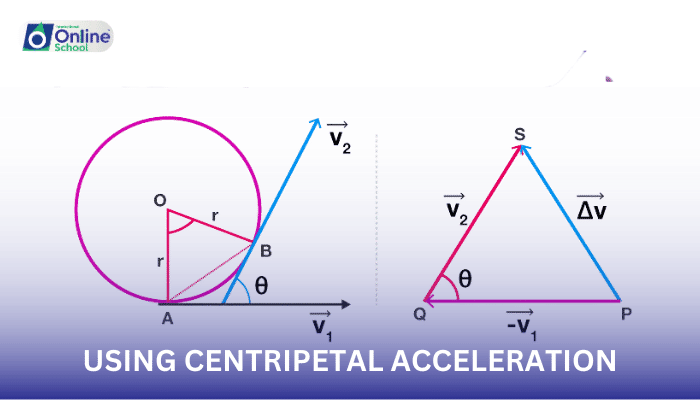
Consider an object moving in a circular path with radius of curvature (r) and linear velocity (v). As the object travels along the circular path, its direction is constantly changing. This continuous change in direction indicates that the object is undergoing acceleration. The acceleration experienced by an object moving in a circular path is known as centripetal acceleration (a).
To derive the equation for centripetal acceleration, we can consider the small angular displacement (Δθ) and the corresponding short circular arc length (Δs) traversed by the object in a small time interval (Δt). Using the formula for angular velocity (ω = Δθ/Δt), we can express the linear velocity (v) as v = rω.
Now, applying the concept of instantaneous acceleration, we can define centripetal acceleration as the rate of change of linear velocity:
a = Δv/Δt
Substituting the expression for linear velocity in terms of angular velocity, we get:
a = (Δrω)/Δt
Dividing both sides by Δt and rearranging, we obtain the equation for centripetal acceleration:
a = rω²
ii. Understanding Centripetal Acceleration
Centripetal acceleration is always directed towards the center of the circular path, acting perpendicular to the direction of motion. This inward direction is crucial in continuously changing the object's direction and keeping it on the curved path.
The magnitude of centripetal acceleration is directly proportional to the square of the linear velocity (v²) and inversely proportional to the radius of curvature (r). This means that higher speeds or smaller radii lead to greater centripetal accelerations.
iii. Applications of Centripetal Acceleration
The concept of centripetal acceleration has wide-ranging applications in various fields:
Engineering: Engineers use centripetal acceleration to design and analyze rotating machinery, such as centrifuges and turbines.
Physics: Centripetal acceleration is essential in understanding various phenomena, such as the motion of planets and satellites, the behavior of objects in curved paths, and the dynamics of circular motion.
Everyday Examples: We encounter centripetal acceleration in everyday life, from the motion of a car turning on a circular track to the swinging of a pendulum or the swirling of a ball in a centrifuge.
Centripetal acceleration provides a fundamental understanding of the acceleration experienced by objects moving in circular paths. By recognizing the direction, magnitude, and applications of centripetal acceleration, we gain a deeper appreciation of the intricate nature of circular motion and its significance in various physical phenomena.
